
The Art of the Click: Mastering Facebook & Instagram Ads for Real Estate Leads
On this pageView sections
Real Estate Lead Generation
Real estate lead generation in today’s busy real estate market isn’t as simple as just listing a property. Doing only that is like whispering in a hurricane—no one will hear you. To stand out, get steady, good-quality leads, and sell homes faster, you need to show up where your potential clients spend their time. Right now, that place is Facebook and Instagram, where billions of people are active every day.
Old methods like billboards or flyers don’t work as well anymore. Modern social media ads are much more powerful. They let you reach the exact type of buyer or seller you want. It’s not just about putting an ad out there—it’s about creating something so interesting that it makes people stop scrolling, click, learn more about your property, and eventually become your client.
Let’s explore how smart real estate agents can use Facebook and Instagram ads to bring in a steady flow of affordable, high-quality leads through simple and effective real estate lead generation strategies.
Why Facebook & Instagram Are Real Estate Goldmines?
Before we dive into the “how-to,” it’s essential to clearly understand the “why” behind leveraging Facebook and Instagram for real estate lead generation:
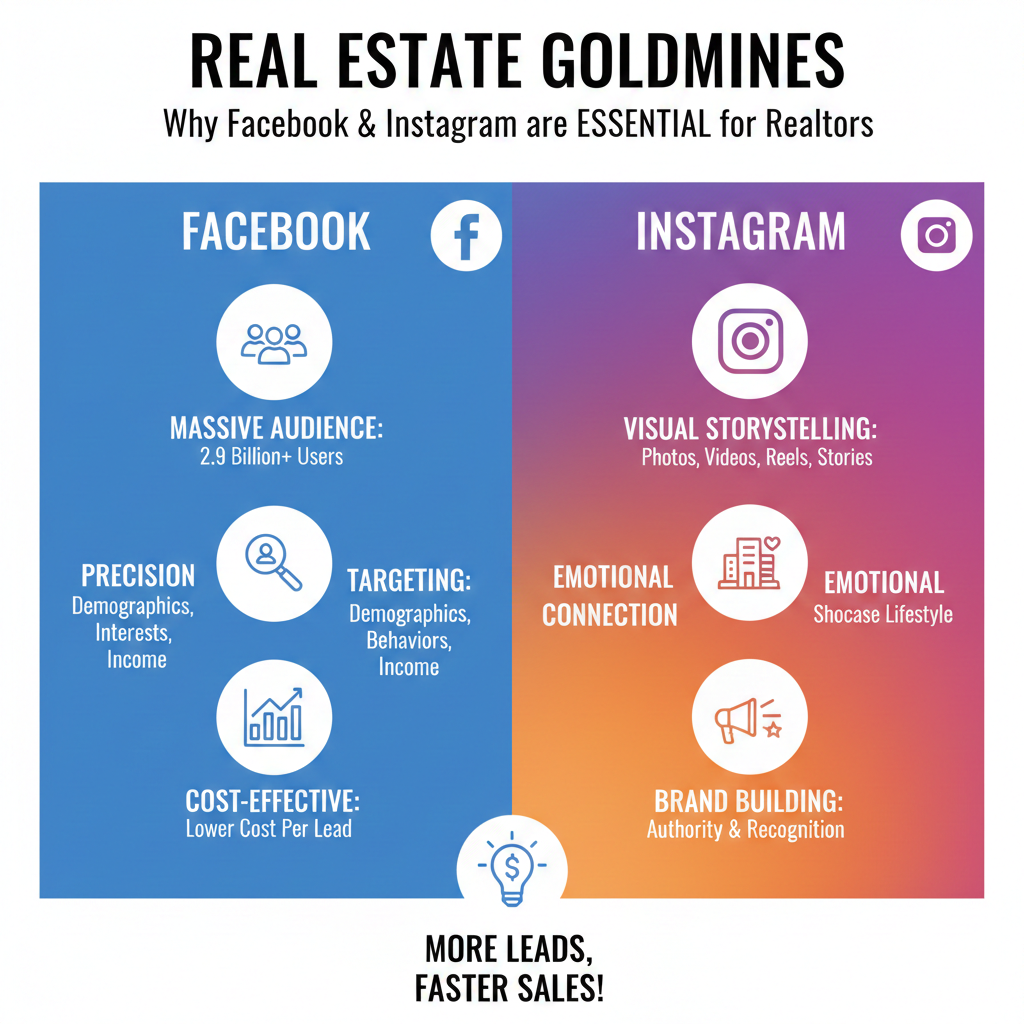
Unrivaled Audience Reach: Facebook commands an extraordinary 2.9 billion monthly active users, while Instagram engages over 1.4 billion. No matter your niche, your ideal audience is not only present on these platforms—they’re actively consuming content every day.
Precision Targeting Capabilities: This is the undeniable game-changer for effective real estate lead generation. These platforms enable you to target users based on highly specific criteria: detailed demographics, niche interests, online behaviors, income ranges, homeownership status, life events such as “likely to move,” and even custom audiences built from your own contact lists for hyper-personalized campaigns.
Visual Storytelling at its Best: Real estate is by nature visual and emotion-driven. High-quality photography, immersive video walkthroughs, and eye-catching property graphics excel on these platforms, creating emotional resonance that static or text-heavy ads cannot match.
Exceptional Cost-Effectiveness: When executed thoughtfully, social media ads deliver qualified leads at a lower cost per acquisition compared to traditional marketing channels, resulting in a highly favorable return on investment.
Robust Brand Building: Beyond immediate lead capture, consistent, polished ad content elevates your brand presence, strengthens local authority, and reinforces your reputation within the market.
The Ultimate Real Estate Lead Generation Strategy: Mastering Facebook & Instagram Ads
Mastering social media advertising transcends merely “boosting a post.” It demands a sophisticated, strategic, and iterative approach.
1. Define Your Objective (and Your Audience with Precision)
Before launching any campaign, clarity on your ultimate goal is paramount:
- Lead Generation: Your primary aim is to systematically collect contact information (names, emails, phone numbers) from genuinely interested buyers or sellers.
- Brand Awareness: The objective is to significantly increase the visibility and recognition of your agency or personal brand within your target demographic.
- Property Promotion: The goal is to drive highly qualified traffic directly to a specific property listing page, generating immediate interest.
- Open House Promotion: Your aim is to maximize attendance at an upcoming showing, converting online interest into physical visits.
Once your objective is crystal clear, meticulously define your target audience. Consider their psychographics and demographics:
- First-time Homebuyers: Typically 25-34 years old, interested in starter homes or apartments, potentially sensitive to student loan debt.
- Luxury Property Buyers: Often 45+, high-net-worth individuals, interested in exclusive amenities, golf courses, or investment properties.
- Empty Nesters Downsizing: Generally 55+, interested in retirement planning, travel, low-maintenance living, and potentially selling a larger family home.
- Sellers in a Specific Neighborhood: Homeowners within a defined geographic area, actively interested in local market trends, property valuations, and selling services.
2. The Unparalleled Power of Precise Targeting
This is where Facebook and Instagram truly differentiate themselves. Abandon broad-stroke marketing; embrace laser-focused targeting.
Demographics: Leverage age, gender, relationship status, education level, specific job titles, and even parental status to refine your audience.
Location-Based Targeting: Pinpoint specific zip codes, entire cities, or even draw a precise radius around a particular property or your office location.
Interests: Target users who have demonstrated interest in keywords such as “Zillow,” “Trulia,” “Real Estate Investing,” “Luxury Homes,” “Interior Design,” “Mortgages,” “Home Decor,” or “Financial Planning.”
Behaviors: Utilize powerful behavioral data like “Likely to move,” “First-time home buyer,” “Residential property interest,” “Engaged Shoppers,” or those interested in specific property types (e.g., “condos,” “single-family homes”).
Custom Audiences: Upload your existing email lists to directly re-engage past clients or prospects. Crucially, create “lookalike audiences” – new users who share statistically similar characteristics and behaviors with your highest-value clients, dramatically expanding your reach to qualified leads.
Retargeting (Remarketing): This is one of the most potent strategies. Show targeted ads to individuals who have previously visited your website, interacted with your Facebook page, or engaged with your past social media content. These users are already familiar with your brand and are often much closer to conversion.
3. Compelling Creative: Stop the Scroll!
Real estate thrives on visual appeal. Your ads must be arresting and emotionally resonant to break through the noise.
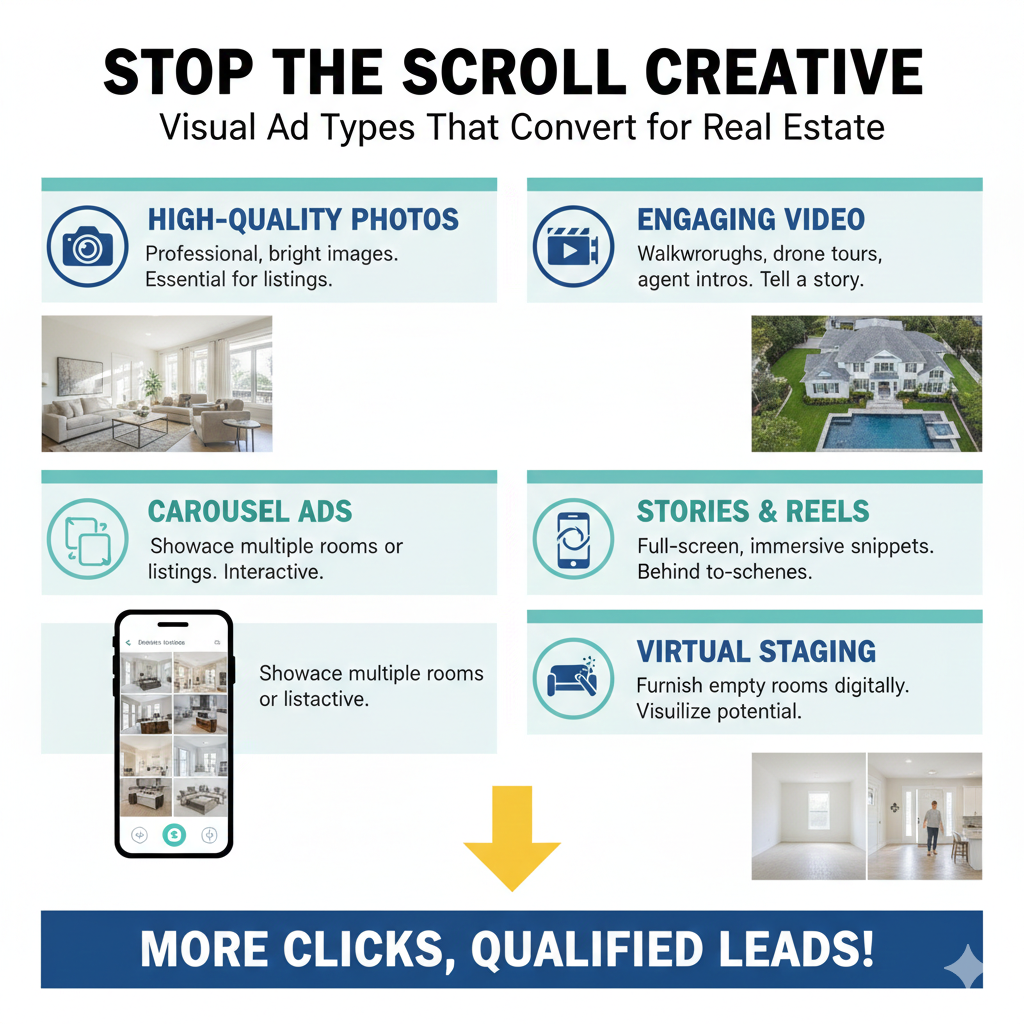
High-Quality Photography: This is not optional; it is fundamental. Professional-grade photos, ideally taken by a real estate photographer, make an immeasurable difference in perceived value and engagement.
Engaging Video Content: Video consistently outperforms static images in terms of engagement and conversion.
Property Walkthroughs: A concise, well-produced 60-second video tour is infinitely more impactful and immersive than a series of static photos.
Agent Introductions: Build rapport and trust by allowing potential clients to “meet” you and understand your personality and approach.
Neighborhood Spotlights: Sell the lifestyle and community, not just the physical structure. Highlight local amenities, schools, parks, and unique features.
Drone Footage: Showcase the property’s expansive size, unique architectural features, and its relationship to the surrounding landscape.
Behind-the-Scenes: Offer glimpses into your team, your process, or client success stories to humanize your brand.
Carousel Ads: Effectively showcase multiple angles of a single property, highlight different features, or even present several distinct listings within one interactive ad unit.
Facebook & Instagram Stories/Reels: Leverage these full-screen, immersive formats for quick, dynamic, and authentic property snippets. They’re perfect for “day in the life” content or quick property tours.
Virtual Staging: For vacant properties, utilize AI-powered virtual staging tools to transform empty rooms into beautifully furnished spaces, helping potential buyers envision the home’s full potential.
4. The Call to Action (CTA) Frictionless Lead Forms
A powerful ad requires an explicit instruction. Never leave the user to guess their next step. Your Call to Action (CTA) must be clear, concise, and compelling:
“Learn More” (Best for driving traffic to a detailed property page).
“Get Quote” (Ideal for seller lead generation, offering a home valuation).
“Sign Up” (For market update newsletters or neighborhood alerts).
“Download” (A free buyer’s or seller’s guide/checklist).
“Request a Showing” (For high-intent buyers ready to view a specific home).
For pure lead generation, leverage Facebook and Instagram’s native Instant Forms (Lead Ads). This format is supremely effective because users can submit their pre-filled contact information (name, email, phone number) with just a couple of taps without ever leaving the platform. This drastically reduces friction, which is the single biggest determinant of conversion rates. Ensure your Lead Form includes a specific, high-value offer (e.g., “Get the Top 5 Investment Properties in [City Name]”).
5. Budgeting & Testing: Optimizing for Success Through Data
Mastering ad performance is an iterative process driven by data, not guesswork.
Start Small, Scale Strategically: Begin with a modest, controlled budget. Focus your initial spending on A/B testing different ad creatives, targeting parameters, headlines, and CTAs.
A/B Testing Discipline: Simultaneously run multiple versions of an ad that isolate a single variable. For example: Does a video ad outperform a carousel ad? Does targeting “Likely to Move” yield better leads than targeting specific income levels? Once you identify the statistically significant winner, turn off the underperforming ad and reallocate its budget to the successful one.
- Monitor Core Metrics: Dedicate time daily to tracking your campaign’s performance in the Ads Manager. Key metrics to prioritize include:
- Cost Per Click (CPC): How much you pay for each person who clicks your ad.
- Click-Through Rate (CTR): The percentage of people who see your ad and click it (a high CTR indicates compelling creative/offer).
- Cost Per Lead (CPL): The actual cost of acquiring a single contact’s information (this is your most critical metric for lead gen).
- Conversion Rate: The percentage of people who click the ad that successfully complete the desired action (e.g., fill out the lead form).
- Iterate and Optimize: Use the robust analytics provided by Facebook/Instagram to inform your next steps. Continuously refine your campaigns: pause creatives with low CTRs, refine targeting groups with high CPLs, and scale up the budget for your top-performing ad sets.
| Scenario | Primary Objective | Audience Targeting | Recommended Creative/CTA |
| New Listing Promotion | Drive qualified traffic to property page & collect buyer leads. | 5-10 mile radius of property; Interests: Zillow, Trulia, Home Buying; Behavior: Likely to move. | Stunning professional video tour or carousel; CTA: “Learn More” or “Request a Showing.” |
| Seller Lead Generation | Identify homeowners considering selling. | Homeowners in target neighborhoods (age 40+); Interests: Home Valuation, Real Estate Investing, Home Improvement. | Headline: “What’s Your Home Worth in [Neighborhood Name]?”; Use a Lead Form; CTA: “Get Free Valuation.” |
| Open House Promotion | Maximize physical attendance at a showing. | Local audience (5-mile radius); Behavior: Residential property interest. | Video snippet of the property’s best features; Include date/time in ad copy; CTA: “RSVP to Attend.” |
| Brand Awareness/Agent Promotion | Build authority and trust within the farm area. | Lookalike Audience based on past clients; Local community interests. | Agent Introduction Video, Client Testimonial Video, or Local Market Update Infographic; CTA: “Contact Me” or “Follow Us.” |
Final Thoughts: Beyond the Click, The Follow-Up
Remember, a successful ad campaign delivers leads, but it doesn’t close sales. The ad is merely the introduction; your follow-up is the commitment. The moment a lead form is submitted, your brokerage’s internal process must be lightning-fast.
Speed, personalization, and persistence are the three pillars of converting digital leads into actual clients:
- Speed: Contact the lead within 5 minutes of submission. Response time drops dramatically after this window.
- Personalization: Reference the specific ad and offer they responded to (e.g., “I see you requested the ‘What’s Your Home Worth’ report…”).
- Persistence: Leads often require multiple touchpoints (emails, texts, calls) before they engage. Implement an automated and personalized follow-up sequence.
Mastering Facebook and Instagram ads is an ongoing commitment to learning, testing, and adapting based on real-time data. But by understanding the tools, laser-focusing on your audience, and consistently delivering high-quality, compelling content, you can transform your social media presence from a simple posting channel into a sophisticated, scalable, and powerful real estate lead generation machine for your business. With the right systems in place, real estate lead generation becomes predictable, repeatable, and highly profitable.
Need Help Mastering Your Real Estate Digital Marketing?
Feeling overwhelmed by the technical intricacies of setting up hyper-targeted social media campaigns, understanding funnel optimization, or crafting compelling ad copy? That’s precisely where MediaPulse360 steps in.
At MediaPulse360, we specialize in building bespoke, high-performing digital marketing strategies engineered to deliver tangible, measurable results for real estate professionals. From managing complex, hyper-targeted Facebook and Instagram ad campaigns that consistently lower your Cost Per Lead (CPL), to implementing robust SEO strategies and crafting engaging content funnels, we manage the technical complexities so you can dedicate your energy to what you do best: selling homes and building client relationships.